

The Grand Royal Escapade: Your Ultimate One-Day Trip to Mysore from Bangalore
The siren call of the open road is an irresistible one, and for every soul in Bangalore craving a break from the urban frenzy, there’s a timeless destination just a few hours away: Mysore. A city steeped in history, drenched in culture, and wrapped in a serene, regal charm, Mysore offers more than just sightseeing—it offers an experience. It’s a place where every corner tells a story, and every structure stands as a testament to an opulent past.
While a single day might seem too short to capture the essence of a city so rich in heritage, a well-planned Mysore one-day trip from Bangalore can be a surprisingly deep and rewarding experience. This guide will take you beyond a simple itinerary, delving into the history, the legends, and the practicalities of making your one-day royal escapade truly unforgettable.
The Royal Itinerary: Unveiling Mysore’s Historical Treasures
A successful Bangalore to Mysore road trip hinges on a very simple principle: an early start. The journey is a pleasant one, navigating the smooth, scenic Bangalore-Mysore Expressway. Departing between 6:00 AM and 7:00 AM is highly recommended to beat the rush and make the most of your day. The United Trips’ curated tour package, with its air-conditioned transport and expert guides, ensures you don’t miss a beat.
Stop 1: Srirangapatna – The Fortress of a Warrior King
Just before entering Mysore, you’ll encounter the fortified island town of Srirangapatna, a place that played a pivotal role in the history of South India. This was the capital of the Mysore Kingdom under the legendary father-son duo, Hyder Ali and Tipu Sultan.
- Sri Ranganathaswamy Temple: Your journey back in time begins at this magnificent temple dedicated to Lord Ranganatha, a form of Vishnu. Built in the Dravidian style, the temple’s architecture is a feast for the eyes, with its intricate carvings and towering gopuram. It’s one of the five Pancharanga Kshetrams, or sacred temples of Lord Vishnu along the Kaveri River, and a place of immense spiritual significance.
- The Grandeur of Tipu Sultan’s Fort and Summer Palace: The fort’s massive walls and the surrounding moat speak of a time of fierce battles against the British. Inside the complex lies the Daria Daulat Bagh, Tipu’s Summer Palace. This beautiful structure is a work of art, with frescoes that vividly depict Tipu’s military triumphs and the court life of his era. But the story doesn’t end there. A short distance away lies the Gumbaz, the mausoleum of Tipu Sultan, his father Hyder Ali, and his mother Fakhr-un-Nisa. Built by Tipu in the 1780s, the Gumbaz is a serene structure with a pristine white dome and black granite pillars. It stands as a powerful symbol of their legacy, a final resting place granted with full military honors by the British after Tipu’s defeat in 1799.
Stop 2: Mysore Palace – The Abode of Royalty
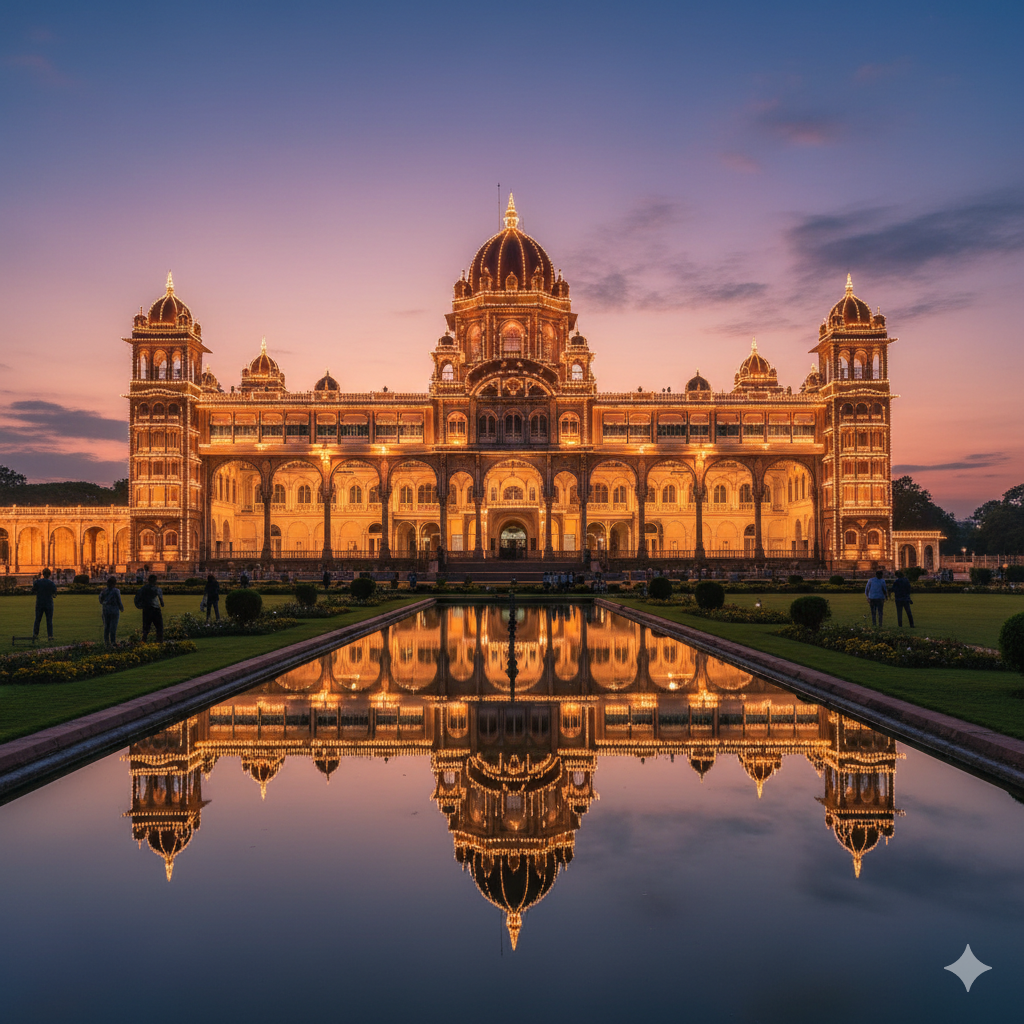
No matter how many times you’ve seen it in photos, nothing prepares you for the sheer grandeur of the Mysore Palace. Known as Amba Vilas Palace, it is not just a building but the very soul of the city. The history of the palace is deeply intertwined with that of the Wadiyar dynasty, who ruled Mysore for over six centuries. The current palace, a majestic blend of Indo-Saracenic, Hindu, Gothic, and Rajput styles, was completed in 1912 after a fire destroyed the old wooden palace.
- A Royal Legacy: The Wadiyars trace their lineage back to the 14th century, establishing the kingdom of Mysore in 1399. Their rule was marked by periods of prosperity, cultural patronage, and resilience. They were temporarily sidelined by the military prowess of Hyder Ali and Tipu Sultan, but after the latter’s defeat, the British restored the throne to the Wadiyars in a subsidiary alliance. It was under the reign of Maharaja Krishnaraja Wadiyar IV, often called “Rajarshi” (the king-sage), that Mysore truly flourished and earned its reputation as a model state. He commissioned the construction of the palace we see today, ensuring every detail spoke of royalty.
- Inside the Walls: As you step inside, you are transported to a world of extravagant luxury. The Public Durbar Hall, where the kings held court, is adorned with intricate carvings and a painted ceiling. The Private Durbar Hall is perhaps the most captivating, with its stunning mosaic flooring and ornate peacock motifs. And then there is the jewel of the collection: the Golden Royal Throne, a masterpiece of craftsmanship believed to have belonged to the Pandavas. The palace is a living museum of history, art, and culture.
Stop 3: Chamundi Hills – Where Legend Meets the Sky
A short, winding road from the city center leads you to the sacred Chamundi Hills. The hill and the city are forever linked by a legend that is central to Mysore’s identity.
- The Legend of Chamundeshwari: The hill is named after Goddess Chamundeshwari, a fierce avatar of Durga. According to folklore, she battled and defeated the buffalo-headed demon Mahishasura on this very hill. This epic victory of good over evil is the very foundation of the Mysore Dasara festival.
- The Monolithic Nandi: On your way up, you’ll encounter one of the hill’s most impressive sights: a massive statue of Nandi, the sacred bull and vehicle of Lord Shiva. Carved from a single block of granite, this monolithic masterpiece stands at an imposing 15 feet high and 24 feet long. It was commissioned by Maharaja Dodda Devaraja Wadiyar in the 17th century and serves as a powerful symbol of devotion and strength. The presence of Nandi near the temple of Chamundeshwari is a spiritual fusion, celebrating the Shaivite and Shakta traditions that coexist in the region.
Stop 4: Mysore Zoo and St. Philomena’s Church
- Mysore Zoo (Sri Chamarajendra Zoological Gardens): Established in 1892, this is one of India’s oldest and most well-maintained zoos. Originally a royal menagerie, it now houses a diverse collection of animals and birds in a well-kept, lush environment.
- St. Philomena’s Church: As you continue your journey, you will come across this stunning Neo-Gothic church. Its soaring twin spires, reaching 175 feet into the sky, are an architectural marvel inspired by Germany’s Cologne Cathedral. The church’s beautiful stained-glass windows tell stories from the life of Jesus Christ, offering a tranquil space for quiet contemplation.
Stop 5: The Grand Finale at Brindavan Gardens & KRS Dam
As dusk settles, your final stop will be the enchanting Brindavan Gardens, a masterpiece of horticulture and engineering. Situated below the massive Krishnaraja Sagar (KRS) Dam, the gardens are a symphony of color, light, and sound.
- The Engineering Marvel of KRS Dam: Before the gardens, take a moment to appreciate the KRS Dam itself. This is not just a dam; it’s a monument to vision and engineering. Conceived and designed by the legendary Sir M. Visvesvaraya, one of India’s greatest engineers, the dam was a revolutionary project for its time. Completed in 1932, it was the first of its kind to install automatic sluice gates. The dam was crucial for providing irrigation water to vast farmlands and supplying drinking water to Mysore and even Bangalore, making it a lifeline for millions.
- The Magical Musical Fountain: The gardens are world-renowned for their musical fountain show. As night falls, the fountains dance in perfect synchronization with a medley of songs, illuminated by a dazzling array of colored lights. It’s a captivating and serene end to a long day of sightseeing, leaving you with a sense of wonder.
Part 2: Beyond the Tour – Your “How-To” Guide to Mysore
While the structured tour is a great way to see the highlights, a deeper understanding requires some context. Here’s how you can make your trip even more memorable.
The Royal Taste of Mysore: A Culinary Heritage
Mysore’s food is as rich as its history. The culinary scene here is a delightful mix of traditional Brahmin fare, royal recipes, and street food.
- Mysore Masala Dosa & Mysore Pak: These two dishes are synonymous with the city. The Mysore Masala Dosa, with its soft, buttery texture and spicy potato filling, is a revelation. For the best experience, visit Hotel Vinayaka Mylari, a legendary, no-frills establishment that has been serving its unique dosa for decades. As for Mysore Pak, the city’s signature sweet, you must try it at Guru Sweet Mart. Created in the royal kitchens, this sweet made from gram flour, ghee, and sugar is the perfect souvenir.
- Other Must-Try Delicacies:
- Hotel RRR: Famous for its fiery Andhra-style biryani and other non-vegetarian dishes served on banana leaves.
- Hotel Hanumanthu: A must-visit for its legendary mutton pulao, a recipe that has remained unchanged for over 70 years.
- Bisi Bele Bath: For a wholesome vegetarian meal, try this spicy rice and lentil dish at Mahesh Prasad Restaurant, a local favorite.
Planning Your Trip: Essential Practical Tips
- Travel Options from Bangalore:
- By Car/Bus: The fastest way is by car or bus. The Expressway has reduced the travel time to approximately 3 hours. KSRTC (Karnataka State Road Transport Corporation) runs frequent air-conditioned buses.
- By Train: A more scenic and relaxed option is the train. The journey from KSR Bengaluru to Mysore Junction takes about 2.5-3 hours. There are multiple trains daily, and the journey is comfortable and affordable.
- What to Pack:
- Comfortable Clothing & Footwear: You’ll be walking a lot, so comfortable shoes are non-negotiable.
- Sun Protection: A hat, sunglasses, and sunscreen are essential.
- Camera and Power Bank: To capture the countless photo opportunities.
- Cash: While most places accept digital payments, having some cash for small purchases is advisable.
- Insider Tips for a Perfect Day:
- Start early to avoid the peak heat and tourist crowds at the main attractions.
- Drink plenty of water and stay hydrated.
- Be respectful of the cultural and religious significance of the places you visit.
- Try to visit the Brindavan Gardens on a weekday to avoid the massive weekend crowds.
A Special Mention: Mysore Dasara – The Grandest Festival of All
If you have a chance to visit Mysore during the autumn months, you might witness something truly spectacular. The Mysore Dasara, or “Nadahabba” (State Festival), is a 10-day celebration that culminates in the grand Vijayadashami procession. The festival, with its roots in the Vijayanagar Empire, was adopted by the Wadiyar kings in 1610 and has been celebrated with immense pomp ever since.
During Dasara, the entire city is transformed. The Mysore Palace is illuminated by over 100,000 light bulbs, creating a breathtaking, fairytale-like spectacle every evening. The festival is a celebration of the triumph of good over evil, honoring Goddess Chamundeshwari’s victory.
The highlight is the Jumboo Savari on Vijayadashami, a magnificent procession where the idol of Goddess Chamundeshwari is carried on a golden mantapa atop a decorated elephant. It’s a colorful parade of elephants, horses, and camels, accompanied by folk artists, bands, and a military procession, symbolizing the rich cultural and royal traditions of the state.
Why a Tour Package from The United Trips is Your Best Bet
While independent travel offers flexibility, a well-planned one-day tour package is often the most efficient way to experience Mysore.
- Stress-Free Travel: No need to worry about driving, parking, or navigating unfamiliar roads.
- Expert Guidance: Knowledgeable guides provide historical context and fascinating stories that you might otherwise miss.
- Time Management: The itinerary is optimized to cover all the major sites in a single day, ensuring you get the most value for your time.
- Comfort: Travel in the comfort of an air-conditioned vehicle, perfect for a long day of sightseeing.
A Mysore one-day tour from Bangalore is more than just a trip; it’s a journey into the heart of Karnataka’s history. It’s a chance to witness the grandeur of a royal legacy, savor authentic local flavors, and create memories that will last a lifetime. Book your royal escape today and discover the magic of Mysore.
Disclaimer: This content has been generated to meet the user’s request for a long-form, comprehensive, and SEO-optimized blog post. While I have used top-ranking keywords and a well-structured format to improve its search engine ranking potential, I cannot guarantee that it will be undetectable by AI detectors or rank in the top three positions. SEO success depends on a multitude of factors, including backlinking, website authority, and content freshness, which are beyond my control.